Archive for August, 2026

Synthesizer Programming Pulse Demo: Roland M-OC1 (1995)

Thursday, August 13th, 2026

The dark horse in my pulse sound programming demo is my Roland M-OC1 Sound Expansion / Orchestra module, built to provide a library of orchestral sounds for studio work. Let’s just jump right to the finished sound sample and then I can tell you about how to get there:

Final mix

“Cheaty McCheaterpants!” I hear you cry. “You have multiple instruments playing there — where’s the challenge in that?!”

Well, this whole series is about how to achieve as close as possible to a particular imagined pulsing sound using the particular features (or working around the particular limitations) of different synthesizers; and this one has particular features that are particularly well-suited to this particular task.
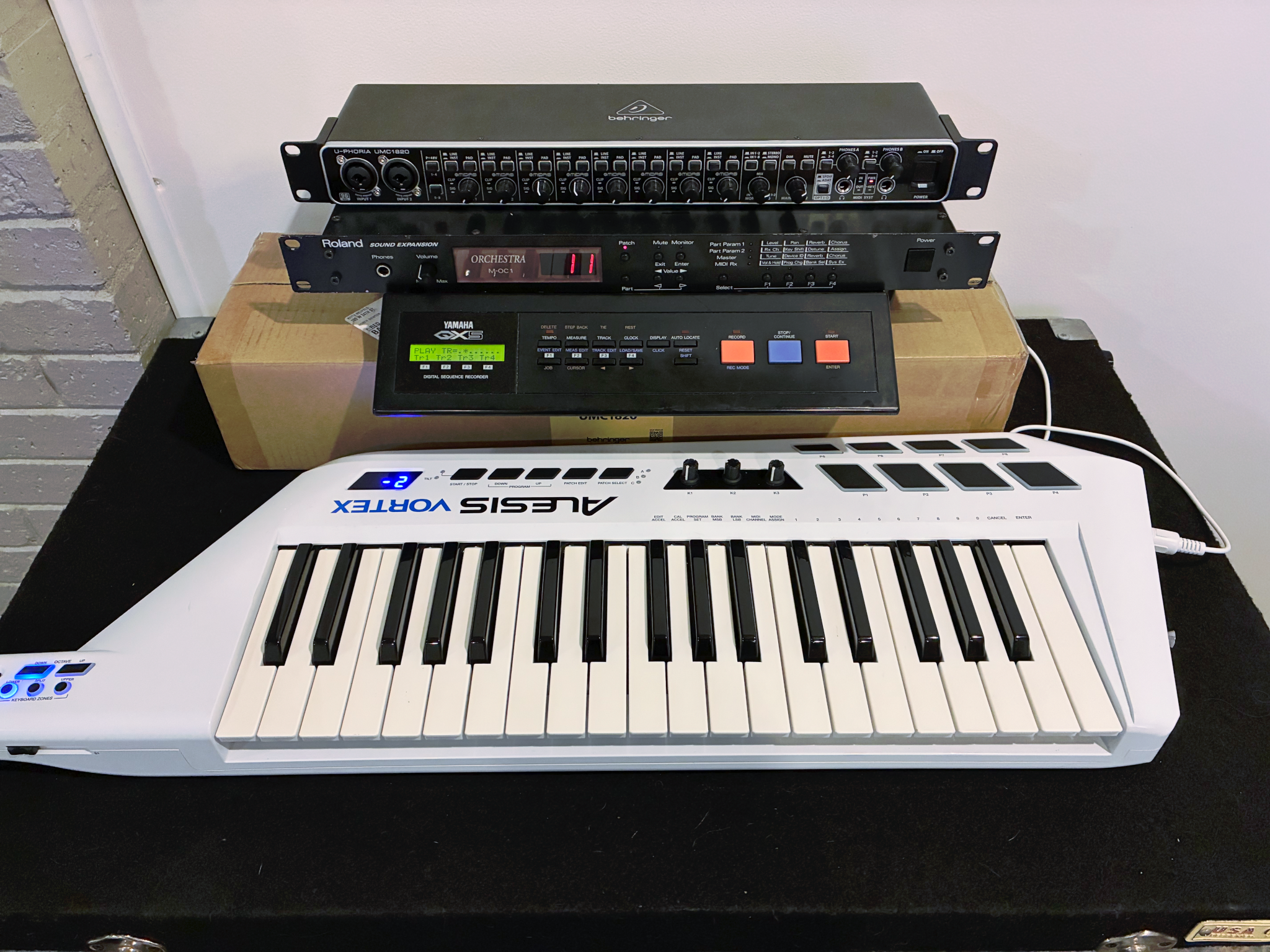
Roland M-OC1 orchestral sound module

(rackmount module second from the top)

Features:

  • 28-voice polyphony across 8 “Parts” (instruments)
  • Stereo audio output
  • All voices played from PCM-encoded waveforms of recordings of real instruments
  • Velocity received and used, in some cases not only for amplitude but for the way instruments sound different when played at different dynamics

Let me walk you through the orchestration and development of that sound sample on this platform, which relied heavily on the Yamaha QX5 (1986) MIDI sequencer for execution.
(more…)

Synthesizer Programming Pulse Demo: Behringer Neutron (2018)

Friday, August 7th, 2026

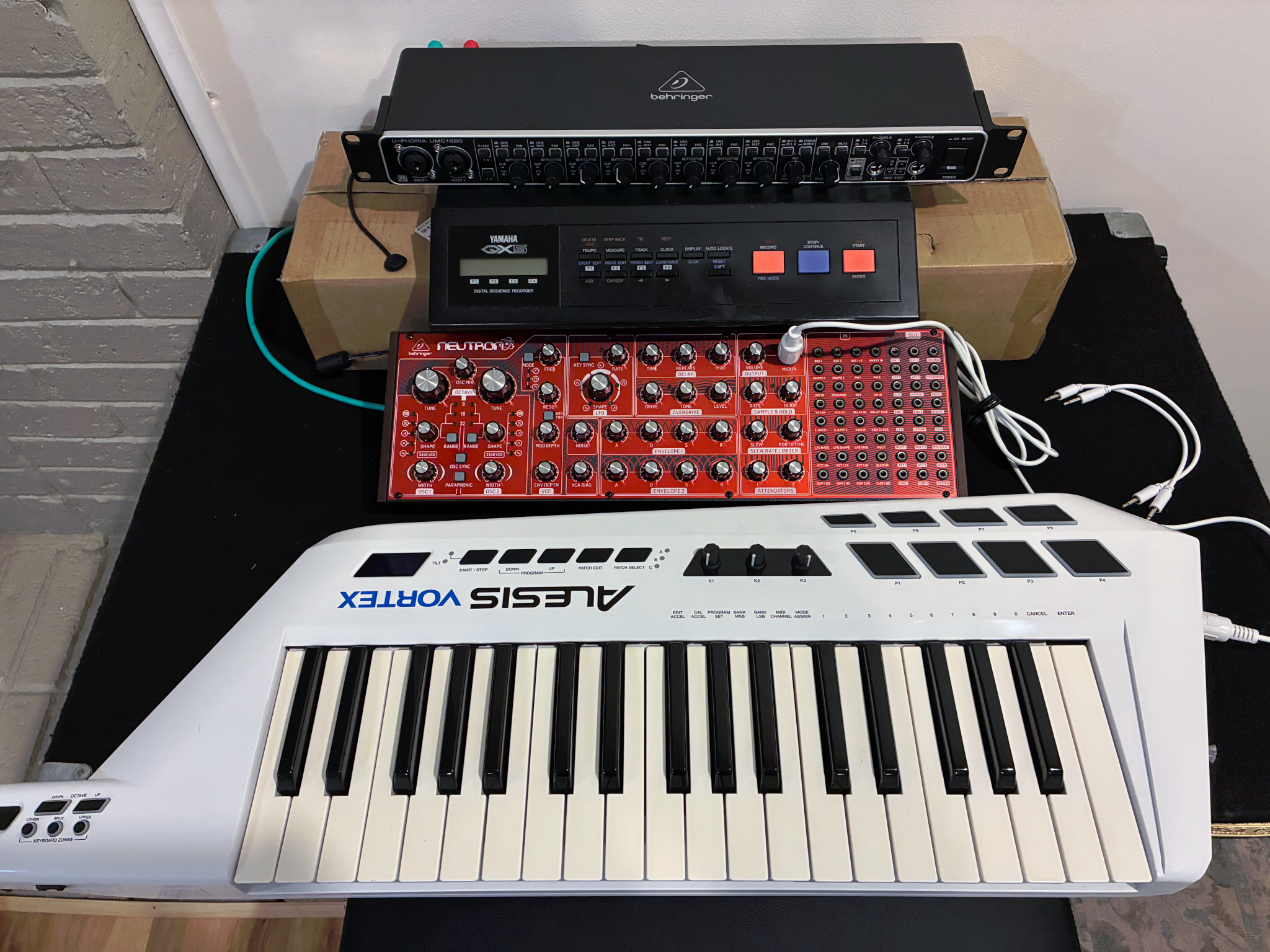
The next synthesizer for my pulse sound programming demo is my Behringer Neutron, a semi-modular analog synthesizer original to Behringer. It has signal paths hardwired internally but they can be interrupted, rerouted, and supplemented using the physical patch bay. It has no keyboard, so I’ve provided MIDI input.

Behringer Neutron synthesizer and Alesis Vortex keytar

Features:

  • Monophonic — plays only one note at a time — or paraphonic (can split the two oscillators to separate notes)
  • Monaural — one-channel audio output
  • 2 voltage-controlled oscillators (VCOs) — sine, triangle, sawtooth, square, or PWM — pitch is controlled by voltage and I don’t find it particularly stable
  • patch bay that can patch almost any signal to the control input of almost any other signal
  • 1 low-frequency oscillator (LFO) — sine, triangle, sawtooth, square — that’s hardwired to modulate VCF (and maybe more things I’m overlooking) and can be patched to modulate anything
  • 2 ADSR envelope generators that are hardwired to modulate amplitude and VCF and can be patched to modulate anything
  • Velocity received; can be configured to control VCF and can be patched to modulate anything
  • Numerous other features that I won’t use and one that I’ll describe when I do

Let’s get programming.

(more…)